Showing posts with label spirits. Show all posts

Wednesday, December 15, 2010

Mississippi & The Spirits of Gettysburg

Confederate troops of Lieutenant General James Longstreet's corps marched into Gettysburg, with the left of his line anchored in Pitzer Woods by the Mississippi Brigade of Brig. General William Barksdale. The Georgia brigade of Brig. General W.T. Wofford formed just outside of the woods, but close behind Barksdale's men. The objective for Barksdale and Wofford was to attack Union troops forming on the Emmitsburg Road and the advanced line at the Peach Orchard.

   Brig General William Barksdale  ( left)

Just before 4 o'clock on July 2, 1863, Confederate artillery along this portion of Seminary Ridge opened fire on the Union batteries stationed in the Peach Orchard. Huddling in the woods, the Mississippi troops listened to the boom of the guns and screech of Union shells crashing through the trees above them. Impatient that his part of the attack was delayed until other troops had gone in first, a fuming Barksdale stormed up and down, stopping only to petition his division commander for permission to go into the attack early.


Almost two hours into the attack, the hot tempered general was given permission to move forward in support of Confederate troops advancing on their right. Barksdale ordered his men to the eastern edge of the woods where the Mississippians dressed their ranks and went to the position of "parade rest" while Union shells burst around them. Though considered a senior in age, General Barksdale was a fiery and fearless leader in battle whose face appeared to "glow with excitement at the prospect of battle." Dressed in a resplendent gray officer's coat highlighted with gold trim, his long gray hair flowing almost to the collar, Barksdale spurred his black charger to the front of his old regiment, the 13th Mississippi. Above the noise of battle, the general spoke a few words of encouragement. He then waved his hat as a signal to begin the charge and his brigade moved forward in an unstoppable wave.

The Mississippi Brigade raced across open fields and sliced through the Union line. It was "The most magnificent charge of the war," as one eyewitness called it. Despite the heroic efforts of two Union regiments near the Sherfy House to slow the Mississippians, Barksdale's soldiers broke through the shaken Union defenders in the Peach Orchard and the Union line began to collapse. Wofford's Georgians followed in Barksdale's path and eventually drove in the last defenders of the orchard before they reached the Wheatfield and beyond.
Barksdale’s Mississippians lost nearly half of their number in the horrific fight on the afternoon of July 2, in the Peach Orchard on the Emmitsburg Road, and en route to Cemetery Ridge. Among them was Barksdale himself, one of 32 generals who fell at Gettysburg.

The Mississippi State Monument stands near this location, selected for this site because of the service of General Barksdale's Mississippi Brigade on July 2.

Sculptor Donald Harcourt DeLue, born October 5, 1897 in Boston, Massachusetts, and died on August 26, 1988 in Leonardo, New Jersey sculpted the monument. He was 76 years old when he completed the Mississippi State Monument. The monument was dedicated on October 19, 1973 and cost $100,000.

The monument to the State of Mississippi at Gettysburg is southwest of town on West Confederate Avenue.
It stands where General Barksdale's Mississippi Brigade began their charge into the Peach Orchard on July 2nd and represents the hand-to-hand fighting of that desperate day. The color-bearer has fallen mortally wounded and his comrade steps over his body, using his clubbed musket to defend the fallen flag.
One of the most conspicuous soldiers on the battlefield is the color bearer. Those who carried the regimental flag into the fight could not carry a weapon, as both hands were required to raise the flag and keep it aloft for the rest of the unit to follow. As a result, the enemies fired at the color bearer more than any other soldier, because if the flag fell, those following it could not continue their charge. On the opposite side, those attacking could not allow the flag to fall. Therefore, as one color bearer was shot down, another, and another would grasp the standard and carry it onward.

Mississippi
July 1st 2nd 3rd 1863
On this ground our brave sires fought for their righteous cause;
In glory they sleep who give to it their lives
To valor, they gave new dimensions of courage
To duty its noblest fulfillment
To posterity, the sacred heritage of honor.


Mississippi was represented on the fields of Gettysburg by infantry brigades of Davis of Heth's division, Hill's corps, consisting of the Second, Eleventh, and Forty-second Mississippi regiments ad the Fifty-fifth North Carolina regiment, which was temporarily assigned to it; Barksdale's brigade of McLaw's division, Longstreet's corps, consisting of the Thirteenth, Seventeenth, Eighteenth and Twenty-first regiments; Posey's brigade of Anderson's division, Hill's corps, consisting of the Twelfth, Sixteenth, Nineteenth, and Twenty-first regiments; Ward's Mississippi battery (the Madison Light Artillery) of Poague's battalion, which was attached to Pender's division.

In addition to these infantry-artillery forces from Mississippi, the Adams County troop of cavalry, the Chickasaw Rangers, and the Kemper County cavalry of Hampton's brigade, Stuart's division, also took part in the battle of Gettysburg.
Mississippi had eleven infantry regiments, one infantry battalion, one cavalry regiment, and one artillery battery , sending over 4,900 men   to Gettysburg, with almost 1,500 becoming casualties.
Confederate Monument listing all the
participating Confederate States (top left)
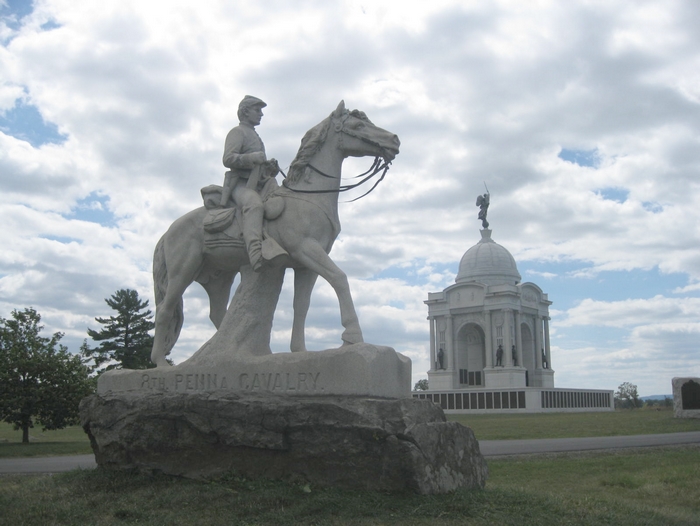
I visited Gettysburg in September 2010 with my fiance Tony. I walked alone out into the wide open pasture which was once the Wheat Field. I felt the thick dark energy that permiated the air, crushing my chest with its heavy weight. The silence screamed at me and I could almost hear the hot breath of wild eyed horses and charging foot soldiers all around me. I did not feel alone in the least.
It was hard to breathe and I felt an overwhelming sense of sadness no matter what area of the battlefield I was walking on. I walked the trails near Spangler's Spring, I stood on Cemetery ridge, where smoke and gunfire once sliced the air. 


I hiked the scenic paths up Little Round Top. I sat behind the rock barricades where the 20th Maine held the Union flanks and where Confederate troops bravely stormed the rocky slopes only to fall to their deaths, Sliced down by the blazing guns that rained down upon them. I heard the trees crying as if they had human voices.  I walked across Slaughter Pen and sat amongst the boulders of Devil's Den, two of the saddest areas I visited. I stood on Confederate Avenue near Pitzer Woods, where the Mississipians charged so fiercely. The sadness I felt while at Gettysburg was overwhelming and I cannot begin to imagine the horrific scenes of death, pain and bloodshed that occured on both sides of the line, in this most beautiful of countrysides. In my opinion there were no real winners of this bloody battle. Both sides of the conflict experienced enormous losses of life.
Many different estimates exist on the number of casualties inflicted during the battle of Gettysburg, but one common estimate is as follows:


Union -Killed 3,155  Wounded 14,530  Missing 5,365  Total 23,040  % of Total 27%

Confederate Killed 2,600-4,500 Wounded 12,800 Missing 5,250 Total 20,650-25,000*
% of Total  30%-34%

* Total Confederate casualties have been estimated to be as great as 28,000. It is usually agreed that total Confederate casualties numbered at least 1/3 of Lee's army.

It is hard to imagine that a conflict so bloody could have happened on such beautiful ground. The feelings of death, pain, anger, sadness and loneliness still lingers in this place.

I firmly believe that the spirits of those who bled and died here, remain to this day. I do not need photographic evidence or scientific proof of their ghostly existence. I felt them with my bones and I heard them all around me, screaming with each gust of wind.


View More of My Gettysburg Photos Here :


History Sources:

Mississippi Monument Photograph © 2008 Patricia A. Hickman
http://militaryhistory.about.com/od/civilwar/ig/Gettysburg-Confederate-State/Mississippi.htm
http://www.nps.gov/archive/gett/getttour/tstops/tstd2-07.htm
http://www.thegettysburgexperience.com/past_issue_headlines/2010/april2010/battlefieldart.html
http://www.gettysburg.stonesentinels.com/Confederate/MS.php

http://msgw.org/desoto/military/gettysburg.html
http://www.militaryhistoryonline.com/gettysburg/getty4.aspx

Thursday, October 21, 2010

Native American Death Masks

by Angela L. - MSSPI

Masks have been worn by man for ritual and ceremonial purposes since ancient times and can be traced to the Egyptian and Roman periods.The Death Mask in most ancient cultures was made of wax or plaster cast of the persons face. Sometimes while alive, but usually after death had occurred. For the wealthy or the royal families, they were often cast in bronze or gold and placed over the deceased face at burial. The process served as a reminder of the deceased for the family as well as being a protection from evil spirits and was associated with the belief in the return of the spirit.

In North American History, every Native Tribe known to have ever existed, has used masks in some ritual or ceremonial purpose. African, Oceanic and Native American tribes considered masks, to be an important part of social and religious life. Some masks were placed over the head and face , while others were simply painted on the face and other adornments and decorations to the head or hair where added.

Some of the more well known masks were made by the Iroquois, especially those belonging to the very secretive and elusive False Face Society. .They were made of wood and corn husks. It has been said that in order to join the False Face Society one must have envisioned a healing mask in a dream and then made or created it as he saw it. Once this was accomplished they were then permitted to participate in the Societies ceremonies.


The Alaskan Yup'ik tribes are said to have made the most decorative and brightly colored varieties. They were made from a number of materials,
usually whatever resources were available in a specific tribal area. Wood, leather, hides, bones, shells or whatever materials might be available.
Masks were usually created with great personal associations for the wearer or the occasion being celebrated.
Stains and dyes from plants, animals, soil and other materials were used to paint the masks, some of them being quite strange combinations such as blood, coal and urine mixed together.

The Anchorage Museum has a collection of over two-hundred Yup'ik masks that were created during the early 19th and 20th centuries.

The arrival of missionaries to the Yup'ik and other Native tribes began to change the making and use of masks among the Native Americans. The missionaries denounced their masked dances as heathen rituals and their use was practically eliminated by the 1920's.
In 1977 the New York Times reported that there were approximately 2000 surviving masks remaining from this period.


The Cherokee created what is known as the Booger Mask. Made from gourds,  and painted with walnut shell or charcoal dye. They were worn for storytelling and worn during the Booger Dance which was a depiction of the arrival of the Europeans to their native land..

The Booger Mask art fell into severe decline when the Cherokee were forcibly removed from their homeland to Oklahoma, where their traditional materials were not available. Read about the Booger Dance Here :


Some North West Coastal tribes had impressively carved cedar masks which could open at a pivotal point in a story to reveal a second mask carved within the first one.The Hopi and Pueblo tribes carved and painted wooden Kachina Masks. Kachina are the symbols of spirits who control crops, weather, health and all other aspects of life. Kachina are also symbols of ancestors who are highly regarded by the Hopi. There are more than five-hundred indivdual Kachina known. Kachina are more commonly know in the form of Kachina dolls. Each doll has it's own special markings, color, and decoration and are used mostly during the winter and summer solstice ceremonies. They are usually carved from Cottonwood trees and range from an inch to a foot in length. Kokopelli is the most popular and well recognized of the Kachina. Kokopelli is a hump backed flute player who is believed to bring good luck, health and happiness to the homes he adorns and is also known as the teacher of Kachina carving.

The Apache and Navajo used leather to make their ceremonial masks. But, the one thing they all had in common was that they all had a ceremonial purpose of some kind for their creators.

Masks were used in a wide variety of ceremonies, including marriage, birth, childhood initiations to adulthood, preparations for war,seed planting, harvesting, hunting, healing and many other occasions including death.

Many tribes used masks in healing rituals. It was believed that masks held spiritual powers that never left them. Because many tribes believed that shamanic powers were genetic, healing masks were often passed down thru the bloodlines of Medicine men and Shaman.

Shaman should not be confused with Medicine men or Medicine women. Medicine people are those who serve as prophets, soothsayers and moral leaders. They are often the tribal storytellers and their services were considered healing. The French called them me'decins or doctors. From this the word medicine became applicable to everything pertaining to these people as well as to anything the Natives held sacred.

Shaman are reportedly capable of bringing cosmic powers into ritual to affect healing. A Shaman must develop and maintain his or her relationship with the spirit world and be always prepared to help others. They are said to receive revelations from the spirits. Shaman are personalities who live in deepened relationships with their cosmology and they assist others to deepen their spiritual relationships with the cosmos around them. They revere and appreciate the Earth and the world around them and they hold the Earth as sacred to their survival.

Medicine hats, though not full face masks were also worn by many shaman and healers throughout the tribes. They were usually adorned with a cross and crescent, representing the four directions and the moon spirits and were painted black, blue, yellow and white which depicted the Four Winds or the East, West, South and North. They were often decorated with such things as, Eagle feathers, turquois gems, beads, shells, deer fur and thong and yellow pollen.

The Hopi tribes and others wore masks while curing and praying over the sick, to alleviate suffering and pain, and to perform exorcisms. Some tribes believed that sickness was caused by malevolent or evil spirits. The Nepcetat mask was worn by the Shaman to predict death. It was literally stuck to the face of the Shaman, if it stayed on during the prayer ritual it meant that the person being prayed for would recover and live. If it fell off during the prayer ritual it meant the person was near death.

Shaman initiates often wore masks during their vision quests, believing that the masks would identify them with the spirits and activate their power. Death masks were believed to facilitate communication between the living and the dead in funerary rites. Some Death masks took the form of animal or bird spirits, allowing the wearer to assume the role of the invoked spirits or to fend off evil. Many Native American tribes believed that birds were a link or messenger between the natural and the supernatural world. It is not unusual to find bird feathers surrounding the masks.


Death masks were also believed to help the deceased soul to pass more easily into the next life. The respect and sacredness of the funeral rites of mask dancing was also believed to protect from reprisals from the dead and prevent the risk of wandering spirits. In some tribes the Death Mask was used in initiatory or homage ceremonies, which recounted the creation story and the appearance of death among human beings.

There were also masks created to resemble the images of bears, wolves, buffalo and otters, and were used to appease the animal spirits. They were often worn in dance ceremonies conducted before the hunt, to ensure that the hunt would be fruitful. This is also seen in African tribal customs where symbols of power animals were depicted, such as, elephants, rams, crocodiles and antelope.
North West Coast Native American Bear Mask carved by the renowed carver Elton La Fountaine from the Cree Tribe


Tsitsistas/So'taeo'o (Cheyenne) quilled horse mask, mid-1800s, Montana. Made from porcupine quills, hawk feathers, brass buttons, seed beads, wool cloth, hide, sinew and cotton thread.
Photo courtesy of the Smithsonian's National Museum of the American

The Black Fish mask was worn before hunting and fishing expeditions and was believed to protect and empower the hunter.

The Swan Spirit mask was worn during spring ceremonies to entice the swans, ducks, geese and other birds to come back from the South and provide nourishment to the Natives. Most of these type masks were buried with their owners or burned when no longer useful.


In traditional American culture, masks are often worn during festive celebrations, occasions or as simple decorations, wall hangings and museum displays. But, Native American masks are not taken lightly by the Native people. Their use is reserved only for sacred ceremonies and rituals. Only a select few are honored with permissions to wear them. Native American masks are as varied as the tribes themselves, their ceremonies and their beliefs. The creatures that they depict are highly personalized and the materials used to make them are unique to the individual tribes and their geographical locations.


Sources:

Books:

Secrets Of The Sacred White Buffalo by Gary Null PhD 1998 by Prentiss Hall
Walking The Twighlight Path by Michelle Belanger www.llewellyn.com
Adair's History of the American Indian by Samuel Cole Williams 1775 (first published in 1930 by the National Society of Colonial Dames of America in Tennessee.)
American Indian Healing Arts Kavasch, E. Barrie, Baar, Karen 1999 USA: Bantam

Online links

http://www.deathreference.com/Da-Em/Death-Mask.html
http://www.experiencefestival.com/native_american_death_ceremony
http://www.native-languages.org/masks.htm
http://www.missionindianfederation.com/native-american-masks.html
http://www.suite101.com/content/native-american-after-life-rituals-a76036#ixzz12mvDvF00
http://www.yale.edu/ynhti/curriculum/units/1998/3/98.03.06.x.html
http://www.britannica.com/EBchecked/topic/367906/mask/9060/Funerary-and-commemorative-uses
http://www.cherokeeheritagemuseum-gallery.org/Friends.html
http://www.taosblue.com/1southwestart/masks/hopi/hopimaskgallery.html
http://www.nps.gov/history/history/online_books/kcc/chap5.htm
http://www.masksoftheworld.com/NoAmerica/Native%20American%20Shaman%20Mask.htm
http://preview.equisearch.com/equiwire_news/horse_nation_exhibition_100609


Tuesday, January 5, 2010

Are Cemetaries Haunted ?

by Angela L Burke


This is a common question and a topic often debated among ghost hunters and paranormal researchers. Skeptics and critics will say that ghosts are figments of our imagination brought on by too much television and over active imaginations. But if you know anything at all about history or the Bible for that matter, you will find that there have been reports of ghosts and spirits in cemeteries for hundreds of years. Before there was such a thing as the syfy channel or scooby doo cartoons. Movie makers and screen play writers didn't invent the idea of ghosts, they borrowed those ideas from historical accounts, legends and stories,Biblical accounts and even works of great poetry from the likes of Poe and Dickens. Many would say, what reason would a ghost have for hanging out with his decaying bones? Why would a ghost want to stay in a cemetery?

Well, I can think of a few reasons right off the top of my head and while I don't believe that all cemeteries are haunted , I do believe that some of them are.

And I will tell you why.

First, cemeteries are filled with sad and lonely emotions that I personally believe can leave, as potent of an imprint on the surroundings, as the emotions that linger in homes, hospitals and other reported haunted places.
It is the place where the body is laid to rest or in some cases is laid in unrest. A place where family members come to visit and grieve, bring flowers and trinkets and spend time talking to their departed loved ones and friends.
I like the way author & paranormal investigator Kenneth Biddle of PIRA put it when he wrote "

" this is not a science with clear-cut rules. The habits and traits of ghosts can change with every case, with every sighting. Cases differ from residual haunting to interactive spirits, all the way to footsteps that go from the second floor to the third but then one night they are heard going from the third to the second. Who knows why that ghost changed its mind? My point here is that ghosts are absolutely the hardest things to predict. The cemetery is also the place we go to visit them, leave flowers or little reminders, to talk to them and to show kids and grandkids that this is where we remember them. We still follow our religious beliefs and say that they are in a better place, but we still associate that grave with the deceased. Well, while we're there, we're putting out emotional energy. Tons of it! Remembering the good times, wishing they could've been hear for some event, missing them. That's a lot of energy, and I would think that that might draw the spirits to us. It would be like a family reunion. Assuming that they can see each other, I would expect grandparents that have passed on to act just as they did while they were alive, showing off their grandkids to other spirits! "


I have to agree that these are valid reasons why a ghost or spirit might choose to hang around the cemetery. Another reason might be that the headstone is the only thing that the deceased has left to tie him to this realm, maybe he doesn't want to let go, out of fear, anger or some other unfinished business. They say that a spirit will likely act the same in death as they did in their earthly life, so is it so hard to fathom, that maybe the spirit just isn't ready to accept his fate and maybe doesn't have anywhere else to go? Or that he has his own reasons for hanging around, be it to protect the bodies of those he loves, possessions or material wealth he may have been interred with, or possibly he was sleeping and some noisy people just woke him up from his rest?

I also think, that it is possible, that spirits can move around wherever they prefer to be. So it is also a possibility that they come and go or appear to just stop in for a visit as some would say, when ever they feel like it. It is also a possibility that they don't understand or don't want to accept their death and by surrendering to the grave they have to admit defeat. I also have a theory that I have never heard anyone mention. Being from a religious upbringing, I have heard many stories about where the spirit supposedly goes after death, some say heaven, some say hell, some say purgatory, some say they sleep until Christ returns in the rapture. Well, I don't know about you , but if you look at my insomniac sleeping patterns, I do little sleeping here in this life and I think it is a possibility that some of them are just plain restless from waiting. Many are also buried near their loved ones, so who is to say they aren't visiting with them while they wait? Not to mention, if you really look at the whole picture, century after century of people have lived, and died on this planet and some have been buried century after century on top of each other. In reality, your house could be sitting on a lost cemetery and you don't even know it. Many of the places that we think of as big cities and subdivisions, were once, farmlands, wood lands, Native American homesteads as well as battlefields and places of skirmishes and places where people may have been buried while migrating to the west or pitching their cabin . So who is to say there aren't bodies buried in your backyard. It is possible. And could be the cause of why some houses are haunted in my opinion.

I have had many personal experiences in cemeteries. I have loved visiting them since I was a child. My grandparents use to take me to the family cemetery all the time when I was little, I would walk around and explore while I waited for them to put out the flowers and clean up the grave sites. I had one experience there when I was a child, I saw a small girl sitting alone under a huge tree, she appeared to be picking clover and humming. She looked up at me and smiled and then vanished into thin air. I have revisited this area of our family cemetery many times over the years and have recorded EVP of a little girl humming on at least two occasions under that same tree.

EVP stands for Electronic Voice Phenomena - the recording of a voice or sound  on a digital or tape recorder not heard by the human ear at the time of recording but is audible on playback. It is theorized that EVP are the disembodied voices of the dead. while there is no scientific proof that they are spirits of the dead, there is so much evidence to support the possibility, that it is widely accepted among many paranormal researchers as scientific data worth including.

I have seen and photographed images that appear to be apparitions, and recorded over 100 EVP or Electronic Voice Phenomena in cemeteries. So I believe that as paranormal investigators, if we are going to include evp as possible evidence of hauntings in homes and other places, why would we exclude those EVP recorded in cemeteries?

Yes, sometimes they are harder to record due to external noises and audio contaminates, which is why cemetery recordings are excellent training for EVP techs and investigators, after many hours of listening to them, you become familiar with the sounds that natural things make, such as leaves crunching, wind,walking in grass, birds, passing cars, airplanes and voices that carry, but when a voice speaks into your recorder clear and plain, or answers your questions directly and you know that you were alone....well, then you might have a different opinion of the possibility of ghosts in cemeteries.The argument that there is too much daytime noise contamination might be true depending on the location, but if you have ever been on a dirt road in the middle of nowhere in the middle of a summer night at a cemetery, you will realize that the night time is not as quiet as you might think and comes with its own set of noises to be logged and identified. Exp, crickets, frogs, owls, critters, etc... I personally believe that if you are experienced with EVP and the documenting of sounds you do hear during the session, that you will be able to pick out what is natural and what is unexplainable. I have been on many home and indoor invewstigations where external traffic noise and voices from the outside have been audible. Working with recordings from cemeteries is an excellent way to train the ear to recognize external noise. A good , clear EVP is usually hard to discredit especially if you are a good note taker and are paying attention to your surroundings..

I have recorded voices telling me their names without my asking and then I stop and read their headstone, not knowing that they had whispered it to me, just prior. I have heard angry voices, telling me to leave, recorded voices asking me to take their picture and I have heard recordings of voices telling me how they died as well as asking for specific members of their families or items they are looking for. I have been told that I'm stepping on their grave as well as being told that they are standing right behind me and don't seem to understand why I can't see them.

I think it is important when investigating cemeteries or any other areas presumed to have spirit activity, that investigators show respect for the dead and speak to them as you would want to be spoken to. I am not very impressed by researchers who provoke in cemeteries, or any other places for that matter except maybe the jail house or a place where hard core spirits might loom such as pubs and saloons. I think that you catch more flies with honey than vinegar, but that is my own personal opinion, but, I do make it known to those who I investigate with, that I do not approve of provoking spirits for the sake of a reaction in the cemetery. I have the utmost respect for burial grounds and those who are interred there. Cemeteries are sacred , hallow ground in my opinion and should be treated as such.

I also do not discredit the theory that cemeteries could hold portals, where spirits can possibly enter and leave our realm at certain times. One Sunday morning several hours before church, at the family cemetery I spoke of earlier, my fiance' Tony and I  went to investigate on a beautiful sunny morning, no wind, no noise other than an occasional bird or cow from a nearby pasture and out of 2 hours of audio we recorded 19 minutes of the strangest sounding EVPs I had ever heard. Increasing weird static mixed with voices of men and women some talking, some crying, some screaming. the static escalated the farther into the old section we walked. The clip was taken apart and analyzed by a retired Navy Radio Specialist and he sent it back to me in disbelief, he claimed to have counted over 23 unexplained voices all recorded on decibel levels that cannot be heard by the human ear,so many in fact he could not separate them all. At this same time, Tony and I both had experiences of hearing footsteps, having cold chills, static charge on the hair of the neck,  feeling dizzy and nauseated, difficulty breathing and the general feeling of being rushed out of the cemetery. We never heard any of the sounds at the time. We ruled out external utility wires and radio contamination due to the decibel levels of the recordings, the lack of visible electrical lines, and the rural location and we have been back on numerous occasions to the same area and have not been successful in recreating this noise which ended as abruptly as it started as soon as we left the old section of the cemetery. the recording returned to normal for the remainder of our time there. we could find nothing wrong with our equipment.

One tip I would suggest to new investigators is that they don't limit themselves to doing just night time visits. The majority of paranormal activity I have experienced in cemeteries has occurred in the daytime.In fact I can probably count on both hands the EVP I have recorded at a night time investigation. I do not believe that ghosts only come out at night. Not to mention, it is a lot safer to go in the daytime. Cemeteries, especially rural ones are filled with sinking holes, uneven ground and obstacles that can be dangerous to your physical well being, even if there are no ghost, not to mention random sometimes deadly critters and creepy humans that like to come out at night. The last night time investigation I went on, was cut short, due to the very ,scary screeching/screaming sounds of what my dad describes as, a wild cat or a panther. So I would suggest that until you have been there several times in the daylight and know your way around the area very well, that you avoid concentrating on night time investigations. In fact, in some states, such as our Great State of Mississippi, it is illegal to be in the cemetery after dusk especially if gated, without specific permission from the cemetery owners. On daytime investigations, there usually, is not a problem with permissions, unless it is private owned. If you are unsure about the laws in your area, contact the local authorities who will be more than happy to tell you.

I would also recommend that if you are able to record an EVP in a cemetery, that you visit that area frequently, so that if there is a presence there, that it has a chance to get to know you. I have found it to be most helpful when visiting ethnic cemeteries or places where I have no personal family or friends interred. I can only imagine what the spirits present must think of a white girl they have never seen before,walking into their territoryand  asking them all sorts of questions. I frequently bring flowers and spend a great deal of time just sitting and talking at the headstones where I have recorded EVP on previous visits. One cemetery in particular that I visit often , I feel a strong attachment to several particular headstones and on the last visit, I recorded a woman's voice announcing my arrival by saying my name. It sounds very much like the same voice I have had the privilege of recording in that same area.

The study of the paranormal and the subject of ghost has no clear cut answers, only theories and questions, which is why I do not think cemeteries should be discounted. Just because it might not be our own first choice of places we think, we would haunt. There are many places I can't imagine being stuck in, that are presumed haunted. So what better place to start than at the sites that hold the dead. I think too many paranormal investigators think it is silly to pursue them, and that's fine with me, it just means it will be a little quieter in the places I record and investigate. So in closing, are cemeteries haunted? There is only one way to find out, and that is by investigating them with the same dedication we would give a house or any other place that has reported activity. Visit and investigate one yourself and draw your own conclusions.

If you are interested in hearing some of the cemetery EVP we have recorded, visit our paranormal web site at www.mississippi-spi.com there are numerous cemetery EVP posted on our cemetery pages.

If you have thoughts or comments or stories about cemetery hauntings, please feel free to share them with me in the form of a comment.

Until Next Time............