Tuesday, May 11, 2010

Hillcrest Cemetery Holly Springs Mississippi

Hillcrest Cemetery came into use in the 1830's, following the Chickasaw Secession. Most of the oldest and earliest headstones have long ago crumbled and been carted away. But there are a few remaining stones that mark this early era. Leaving only a small clue as to the original age of the cemetery.
While many prominent plantation families had their own family plots set aside on their own land, there were many prominent citizens, as well as, those whos' wealth did not afford them a private family burial grounds.


Some of the oldest markers left standing at the Hill Crest are :
( Click highlighted links to see Find A Grave Memorials, Photos & Headstones.)


Martha E Blake wife of M Blake who died Sept 12, 1839


Originally, only a few small acres were set aside for the Hill Crest Cemetery, in a tree shaded area at the crest of the hill, but as more and more settlers came into the area, the cemetery was required more room. As the cemetery began to expand, the stables and lot of the Sims Stagecoach Stand was taken in as eventually was the baseball field. The cemetery now encompasses approximately 25 acres.

Will Coyle was the first person to be interred in the new section of the cemetery, the area which was formerly a baseball field, which became part of the cemetery in 1905. Ironically, Will Coyle was killed with a baseball bat.

Hill Crest Cemetery has long been known as Little Arlington to the locals. All but two of the twelve Generals from Holly Springs, who marched away to war in 1861, are laid to rest here.


Brigadier General Absolom M West


Adj-General Thomas A Falconer


Asst. Adj-Genera Harvey W Walker


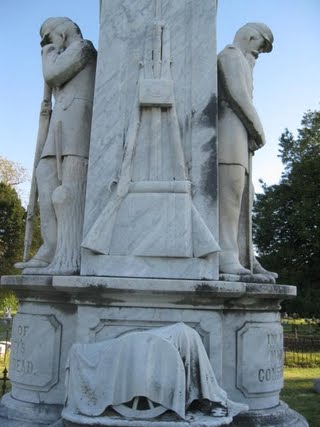
One of Two Confederate Memorials


Micajah Autry one of the martyrs of the Alamo has a memorial shaft here. He perished during the days between Feb 23, and March 6, 1836 when 150 revolutionist were killed at the Alamo Mission in the Texas War of Independence.

Samuel A Cole of the Marshall Guards fell at Matamoros Mexico in October 1846 during the Mexican War is also at rest here.


John Lester, one of eleven men who were the first to be taken prisioner in World War I is honored here with a memorial. He had been taken prisioner with 10 others in the Toul section of France on November 3 1917.Lieut.

Colonel James L Autry was in command at Vicksburg, when a federal fleet under the command of Admiral Farragut steamed up the Mississippi River from New Orleans in 1862. Farragut demanded the surrender of Vicksburg. Col Autry's reply to this demand:

 " Mississippians do not know how how to surrender, nor do they care to learn."


The Federals opened fire on the city, filled with women and children. This bombardment lasted for several day, but caused little damage. Col Autry was killed in battle on Dec 31 1862 and his body was returned to his home in Holly Springs
 
There are also numerous politicians, judges, statesmen and senators buried here including Hiram Rhodes Revels, the first African American Senator of Mississippi, who was liked and respected in the community.


Yellow Fever struck Holly Springs in the 1870's . Six of the twelve nuns of the Sisters of Charity are laid to rest side by side at Hill Crest, they had nursed and cared for the victims of the fever and then became victims themselves. All meeting their fate within a weeks time of each other. Father AnacletusOberti who had taken charge of the Court House hospital also became a victim of the fever and is buried near the sisters. The citizens of Holly Springs out of appreciation of the service so graciously given them by the Sisters and Father Obererti collected funds and erected a monument in their memory the year after the fever epidemic.
When yellow fever first came to Holly Springs in 1870, all who were able fled the town to avoid contamination. Out of a population of 3500, only 1500 were left in the town and 1440 of them contracted the disease.

Mayor Goodrich was the first person to die of the epidemic. He died on August 31st, 1878. You may visit the The Yellow Fever Martyrs Church and Museum (circa 1841) East College Ave., Holly Springs, MS 38635, 662-252-3669, Museum dedicated to preserving the legacy of seven Catholic martyrs who gave their lives during the Yellow Fever epidemic of 1840. Open by appointment only.

Another popular set of headstones at Hillcrest is that of Mammy, the 94 year old nanny of the prominent Coxe Family. She is buried in the family plot in a place of honor with the family she so lovingly cared for. Her tombstone inscription reads " Mammy, Faithful Unto Death"
The small headstone in the photo on the left, that is turned to face sideways, is Mammy's Headstone.


Hillcrest Cemetery is the setting for storytelling as local townspeople, dressed in costumes of the day, re-enacting roles of Holly Springs' most illustrious characters at the Annual Holly Springs Pilgrimage, held every year in April. You can take a walking tour of the cemetery and here stories related to those interred here.

To learn more about the history and lives of those buried at the Hillcrest Cemetery you can also visit the Marshall County Historical Museum located on Van Dorn Ave, you can reach it by dialing 662-252-3669.


See More Photos


Sources:
Find A Grave.com
It Happened Here True Stories of Holly Springs by Olga Reed Pruitt 1950 South Reporter Printing Co
Images Of America Holly Springs by Alice Long & Mark L Ridge 1998
Childhood In Holly Springs A Memoir by Chesley Thorne Smith 1996
http://www.visithollysprings.com/pilgrimage.html
Marshall County Historical Museum

Hillcrest Cemetery
Elder Street
Holly Springs, MS 38635
662-252-2515

Sunday, May 2, 2010

A Tragedy In God's House by Angela L

Christ Episcopal Church
Holly Springs MS
Marshall Co.
 
The Christ Episcopal Church sits magestically on the corner for Randolph & Van Dorn in downtown Holly Springs, Ms. It was built in Gothic style, complete with a slave gallery, gorgeous stained glass windows and fine wood details.

But, the history of, the tragic death of a well known and respected Reverend, would forever linger in this beautiful and quaint  House of God.


The story begins with Joseph Holt Ingraham , formerly head of St Thomas Hall, a diocesan school for boys, and designer and builder of St John's Church in Aberdeen in the early 1850's. He was present as rector at the time of consecration of the Church on October 6, 1858.
 
Joseph Holt Ingraham was born in Portland, Maine, January 26, 1809, the son of James Milk Ingraham and his wife, Elizabeth Thurston. His grandfather, Joseph Holt, was a ship builder and trader, and the grandson shipped on board of one of his vessels as a sailor before he was seventeen and traveled to Buenos Ayres. While in South America he is said to have taken part in a native revolution.

After his return, according to his brother, the Rev. J. P. T. Ingraham, he entered and was graduated from Bowdoin College, but ,it is said that, a search of the Bowdoin College records by the registrar, failed to substantiate this. The Quarterly Church Review says he entered Yale College but was not graduated.
Around 1830, he went to New Orleans, and then to Natchez, Mississippi, where he tried the law, but abandoned it,to become a teacher in Jefferson College, Washington, Mississippi—hence the title "Professor" which was often affixed to his name in his publications. While in this school he began writing, and in 1835 published "The Southwest, by a Yankee." The next year "Lafitte, the Pirate of the Gulf," the first of his novels of the type that was to make his name well known to his contemporaries.


He married Mary Brooks, the daughter of a wealthy planter near Natchez, Ms, became a priest and spent the remainder of his life in parishes across Mississippi. He was the author of romance in his early writing career and later went on to write religious fiction.


On December 8, 1860, Ingraham took a loaded pistol from a drawer in the vestibule of his church while his young daughter waited for him on the porch. It's been said, that there had been some recent robberies in the area, which prompted the Reverend to carry a pistol. It slipped from his hand and in falling to the floor, it discharged. The bullet entered his thigh, passed up his side, and caused intense suffering for some ten days. Joseph H Ingraham died on Dec. 28, 1860. The suggestion of a suicide attempt was reputed by the family and the community believed and still does, that the shooting was an accident.


Inscription:


"Minister of Christ, Scholar, Author, and Rector of Christ Church Holly Springs" Born in Maine. Died in Holly Springs. Erected by J. T. Pickett D.D.

born Jan 28, 1809

died Dec 18, 1860


Reverend Joesph Holt Ingraham is buried on the western edge of the Hillcrest Cemetery in Holly Springs, Ms Marshall County. Today the twisting branches of a giant English Yew, rare in the state of Mississippi, enshrouds his grave and the tall monument is surmounted with a cross. The monument was erected by
 JT Pickett D. D. with donations given by his parish. He was survived by his wife Mary Brooks Ingraham , his son Prentiss, and three daughters.


Special Thanks to Michelle Woodham, volunteer headstone memorial and photo contributor at the find a grave website below. She has graciously volunteered her time to set up over 29,000 memorials and contributed over 57,000 headstone photos to the project. As well as contributing her headstone photos for Joseph Ingraham to this article.

Sources:

Mississippi Home Places notes on Literature and History by Elmo Howell 1988 available for purchase at the Marshall County History Museum, Holly Springs, Ms.
www.ulib.niu.edu/badndp/ingraham_joseph.html- Joseph Ingraham Portrait photo. You can read more at this site.
Photo by Michelle Woodham FindAGrave contributor: Rev Joseph H Ingraham Memorial site:
http://www.findagrave.com/cgi-bin/fg.cgi?page=gr&GSln=Ingraham&GSfn=Joseph&GSiman=1&GScid=59893&GRid=12212059

Wednesday, April 7, 2010

Daltons of Lafayette Co Mississippi

I have been wanting for some time now to write about my relatives. My maiden name is Dalton. I have spent all my life being asked " Are you related to the famous outlaws the Dalton Gang? " While I have spent many years trying to find the answer to this question, I still have not been able to make a connection. But it is really not a big deal to me either way. I would like to share some information that I do know about the family tree. Most of my Dalton relatives are buried at the Shiloh Baptist Church Cemetery in Lafayette Co. Ms.
I have been visiting this cemetery since I was a little girl. I use to go there with my grandparents all the time to put flowers on the gravesites of our departed relatives. I can remember when this cemetery was on a dirt road which dead ended at the cemetery. Now there is a two lane blacktop road right thru the middle of it. The new section across the road from the church was nearly empty in those days but now is almost full.


John Granvill Dalton was born July 7, 1889  in Corinth Ms and lived with his parents James Thomas (Tom) Dalton and Georgia Ann Duncan . He is listed in the 1902 Educatable Children of Alcorn Co Ms, Township 1 Range 9 as being age 12. Along with his brother Ezra age 16, sister Hattie (Holly) age 13, brother Jim age 10 and Sam age 5. Other children not listed were Mandie, Irene and Elmer. It has been reported to me that Ezra and Sam lived in Pontotoc, but I have no information to verify this claim. There is also a family story that Sam owned a grocery store somewhere in Pontotoc and there had been several robberies in the area, so Sam decided to stop the theives by rigging up a shotgun tied to a chair and if someone tried to open the door they would get blasted by the shotgun, unfortunately one day Sam went to open up the store and forgetting about his shotgun rig ,opened the door only to be shot and killed in his own store. There are also claims that Ezra got into a bar brawl one night and beat a man to death. Part of Granvill's farm was sold to pay for his bail. I do not have any documentation as to the truth of these claims, these were stories told to me by my dad.

John Granvill married Pearle Starnes, (pictured above) date of marraige is not know but they had six children James b. May 12, 1914 d. July 20, 1988, Earnest b. July 27, 1916 d. July 7, 1988, Cecil ( dates unknown), Flavil b. 1925 d. 1962, William and Dovie Mae b. Mar 24, 1921 d. Oct 18, 1922. All but Cecil are buried at the Shiloh Church Cemetery. It is said that Cecil lived in Louisiana, but I spoke with him by phone in the late 1990s at which time he was living in Memphis, Tn and was ill with cancer. I do not know what became of him or where he is buried. Flavil died in 1962 at the age of 37.  Uncle William was the youngest and wildest of the bunch and there are many family stories about how he was a moonshine runner back in the day. He passed away in 2006.

Pearl Starnes was born June 13, 1893 and was the daughter of Henry Allison and Josie Starnes, also buried at the Shiloh Cemetery. She passed away April 10, 1954. 

Over the years I have heard many stories about the Shiloh Cemetery from my dad. One story that I have heard many times over the years is that there was an unmarked Confederate Mass Grave at the Shiloh Cemetery which was once surrounded by cannon balls to mark the sight. Over the years, the cannonballs have been stolen one by one and there are no longer any left, so the exact location of the grave site is unknown. There has also been numerous acts of vandalsim at the cemetery, which has contributed to the story that there is a Confederate Soldier who walks the cemetery at night standing guard.  In the early 1950's there were heavy rains in Lafayette Co causing flooding in the cemetery at which time some of the Confederate bodies came to the surface, Granville & his son James  along with other members of the Shiloh church, helped to rebury the bodies. The older section of the cemetery was once overgrown with tall grass, and when I was a little girl, I was not allowed to wander into this section of the cemetery. Now, the cemetery is kept up by members of the Shiloh Baptist Church which sits adjacent to the cemetery and the older section has been cleared.

James Everett Dalton was my grandfather and son of Johnny Granvill Dalton. He was born in Lafayette Co MS May 12 1914. He married my grandmother Grace Donaldson  daughter of Luther Paul Donaldson and Martha Ann Pounds of Paden Ms., on April 22, 1934. They had 5 children, Margarite June b.. July 9, 1936, d. July 10, 1936, Jimmie Morris bSept 5, 1941 D. Sept 6 , 1941, Carol Grace b. Jan 7, 1943 still living in Desoto Co Ms, Jerry Glenn ( my Dad) b. Sept 29, 1946 still living in Marshall Co Ms and Jeanie Diane b. Jan 12, 1949 living in Biloxi Ms.  James Everett Dalton was a retired carpenter of Carpenters Local 345, a US Navy WWII veteran, serving on the ship Proteus during WWII, He was a deacon and member of Beverly Hills Baptist Church in Memphis Tn and died of complications from back surgery on July 20, 1988. He was an avid fisherman and frequently took the grandchildren fishing, he was the first person to teach me how to bait a hook. He was also a wonderful gardener and frequently sold turnip greens, corn, tomatoes, cantalope and watermelons in the front yard of his home in Memphis Tn. Every one knew him as Mr Jim.. He was a quiet man and always had a toothpick in his mouth. I have very   fond memories of my grandaddy and I miss him very much.

This photo above is of 4 generations of Daltons. James E, Granvill, Jerry and his oldest son Jimmie. It was taken at the nursing home a few months prior to Granvills death in 1972.


Baby Pictures of James E Dalton and Grace Donaldson
my grandparents

Headstone of Granvill & Pearl Dalton


Headstone of Earnest Dalton & wife Ophelia


William Daltons grave marked only with a footstone.

Headstone of James Everett & Grace D


Will B Dalton was the brother of Granvill's father Tom Dalton
his wife Katie lived to be 108 yrs old.

The Known Dalton Family Geneology:
Thomas Granvill Dalton b. 1830 in Alabama. He married Jan. 27, 1854 in Tishomingo MS to Sarah Elizabeth Asbell. Thomas Granville died March 1880 in McNairy, TN.
  • Known children: James Thomas Dalton & Mellisa Jane Dalton and Will B Dalton
James Thomas Dalton b. Jan 13, 1859 in TN Married Georgia Ann Duncan b. June 27, 1861 d. Oct 1, 1949
  • Known children: Ezra- b 1886, Hattie ( Holly) b. 1888, John Granvill, b. July 2, 1889, d. Dec 28, 1972, Jim b. 1892, Sam b. 1897, Mandie, Elmer, Irene.
John Granvill Dalton b. July 2, 1889, d. Dec 28, 1972 married Annie Pearl Starnes b June 13, 1893 d. April 10, 1954
  •  Children: James Everett, Earnest, Cecil, Flavil, William and Dovie Mae
James Everett Dalton b. May 12 1914 d. July 20, 1988 married April 22, 1934 to Grace Donaldson b. Jan 17, 1915, d. Aug 4, 1998.
  • Children: Marguerite June, Jimmie Morris, Carol Grace, Jerry Glenn & Jeanie Diane
Jerry Glenn Dalton b. Sept 29, 1946 married Toni Clayton Williams on Sept 3 , 1965

  • Children Angela, Jimmie, Daniel, Deborah & Jeremy
Most of the remaining Daltons and there are too many to list, now reside in Marshall and Desoto Counties in Mississippi

Sunday, March 7, 2010

Where Rebel Spirits Roam

The Confederate Cemetery of Oxford,
Ole Miss Campus
A single, grey, stone monument stands tucked behind a low brick wall, unnoticed by most. It stands in the center of the Confederate Cemetery, behind Tad Smith Coliseum, on the Old Miss Campus, in Oxford, Mississippi. The Albert Sidney Johnston Chapter of the United Daughters of the Confederacy is responsible for placement of both the stone monument and the brick wall. The bodies of 700 soldiers lie silent here. The vast majority are Confederate troops and a small number of troops from Grant's Army. Only a few names are known of the buried soldiers, and these are listed on the plaque of the monument erected in their memory. All those buried here perished on the grounds of the University. Union dead were once buried here as well, but long ago moved to a National Cemetery.

With the outbreak of the Civil War, classes were suddenly interrupted when the entire student body and many faculty from Ole Miss enlisted in the Confederate army. Their company, Company A, 11th Mississippi Infantry, was nicknamed the University Grays, and suffered a high casualty rate during the Civil War. A great number of those casualties occurred during Pickett's Charge at the Battle of Gettysburg on July 3, 1863, when the University Grays made the deepest encroachment into Union territory. Some of the soldiers actually crossed the Union defensive fortification wall, only to be killed, wounded or captured. On the very next day, July 4, Confederate forces surrendered at Vicksburg, Mississippi; the two battles together are commonly viewed as the turning point in the war. When Ole Miss re-opened, only one member of the University Greys was able to visit the university to address the student body.

In June of 1862, following the Battle of Shiloh, Confederate troops began retreating to Oxford bringing with them their wounded many of whom would not recover. These are the earliest recorded burials at the cemetery.

Legend has it, that in 1864, most of downtown Oxford was incinerated by the drunken troops of Union General A. J. “Whiskey” Smith. A few of the buildings on campus survived, including the new observatory, which was preserved by an earlier order from Gen. William Tecumseh Sherman, who wrote to his friend Barnard (whom he had known while teaching at Louisiana Seminary, later to become LSU),

“When I rode through the grounds of the college, I thought of you... and... thought I saw traces of your life, of which I remember you spoke.”


The observatory, restored in 1992, now houses the Center for the Study of Southern Culture.
Following the Battle of Corinth in September of 1862, General Grant and his troops had occupied Oxford and the buildings of the University were used as hospitals and headquarters. Both Union and Confederate forces occupied and used the University property, between 1862 and 1865.

The reason behind having one large monument for those buried in the cemetery, though it would appear as one large mass grave, is said to be due to a costly act of negligence and a sad unfortunate event. Apparently, sometime around 1900, workers on the campus were instructed to clean up the cemetery by cutting the over-grown grass and choking weeds that were smothering out the hundreds of markers and memorials that marked the names of those laid to rest there. Carelessly and without proper thought to consequence, the workers removed all of the markers, in order to make their job easier. In their hurry to save time and effort, they neglected to keep a record of names and marker plots, so when it came time to replace the markers, no one knew which marker, went with which grave.

The dear ladies of the Daughters of the Confederacy, then had the large , single monument erected to replace the lost grave markers. Then in 1936, the original iron fence that encircled the cemetery was in disrepair and was replaced by the current brick wall, using bricks from the previously-burned Gordon Hall on campus.


One chilling story told, is that if you go into the Confederate graveyard at night and sit on one of the unmarked graves, you'll be able to see the Union or Confederate soldiers ghost who inhabits that particular plot.

But....
Death touched more than the cemetery grounds,

There are conflicting stories as to which of the buildings on the campus were used as the hospital. but due to the fact that both sides occupied the campus thruoghout the war, and the number of wounded and dead that came to the campus throughout the occupations, all of the buildings that stood during the war have the possibility of having been used as hospital facilities. Some sources report that the Lyceum building was the hospital.


The Lyceum, was built in 1848, designed by William Nichols, architect. It is the oldest building on campus. In its first year, it housed all of the classrooms and faculty offices of the university.


The Lyceum is now the home of the university's administration offices. The columned facade of the Lyceum is represented on the official crest of the university, along with the date of establishment.


But according to a wikepedia,

The School of Medicine, which was originally located at the eastern gate of the campus, was used as a hospital during the Civil War for both Union and Confederate soldiers, especially those who were wounded at the battle of Shiloh. The School of Medicine is now located in Jackson, Mississippi and the original building, which served as a dormitory for male students in its last years before being condemned in the early 1970s, was replaced by a new Chemistry building in the mid 1970s.

The Y Building

In 1851, the University’s board of trustees planned to build a third dormitory for the growing campus but decided instead to construct what the board called a “large, commodious hall” for student assemblies and commencement exercises.
Completed in 1853 and identified as the Chapel, it soon served as a hospital during the Civil War.
As it became known for housing campus chapters of the YM and YWCAs, it has also been home to the Office of International Programs, student religious organizations, and volunteer services. One of three surviving antebellum structures on campus, the Y Building was renovated in 2000 and now serves as headquarters for the Croft Institute for International Studies.

Barnard Observatory

Built from 1857 to ‘59, Barnard Observatory was the centerpiece of Chancellor F.A.P. Barnard’s ambitious plan to make the University a leading center for science education.
The central portion was to house the world’s largest telescope, but its delivery was prevented by the outbreak of the Civil War. Instead, the telescope went to the Chicago Astronomical Society, which later transferred it to Northwestern University.
Through the years, Barnard has served many purposes. It was a hospital during the Civil War and home to the Department of Physics and Astronomy until 1939, when the east wing became the official residence of the Chancellor. After World War II, the Navy ROTC used sections of the building, and it later became a sorority house.
Barnard Observatory was scheduled for demolition at one point, but then in 1992 was renovated to its former Neo-classical splendor. It is now home to the Center for the Study of Southern Culture

The Dead House
Built in 1929, Farley Hall is one of three buildings on the Ole Miss campus formerly known as Lamar Hall. The School of Law moved into the building in 1931 and there remained until 1978, when the new facility – the Law Center – was opened. The building experienced the first of many expansions in 1958, when a three-story extension was added onto the back of Lamar Hall. This expansion called for the destruction of the one thing for which Farley Hall is probably best known.

The historic marker that stands outside the building does not allow passersby to miss Farley Hall’s claim to fame. It reads, “Dead House.” The small, lead-lined building was originally constructed for use as a magnetic observatory, with intentions for the study of terrestrial magnetism and meteorology. The Civil War caused the building to neglect its purpose, reinventing it as a morgue after the Battle of Shiloh in April 1862. It is believed that 700 soldiers from both sides were carried across campus from this “Dead House” to the cemetery. But this location’s role did not stop there during the Civil War, as it was also used by General U. S. Grant in the fall of 1862 and by forces of General Nathan B. Forrest. Farley Hall’s expansion called for the destruction of this piece of history, and the addition was built in its place.


The Confederate Cemetery and the University Campus are not the only places in town, where restless spirits who rebel against the grave , are said to stir.........


St. Peter’s Cemetery, ( aka Oxford Cemetery ) a few blocks northeast of the bustling town square in Oxford, Mississippi, is full of ghosts: dead rebels and veterans of all the wars, flu and yellow fever victims, professors and mammies, tiny babies and, a statesman or two, such as Lucius Quintus Cincinnatus Lamar, and, some would tell you, writer Willie Morris’s beloved old Labrador retriever, Pete has a spot of his own. Up until a couple of years ago, this was the most peaceful place in town. When Bluebirds still swooped and sang through the old cedars, and deer and silver fox roamed the ancient box woods, owls calling in the dark, and mourning doves crying at dawn. But, the creatures of this once quiet place of rest , are now sharing their tranquility with bustling traffic and city noise polution. Some say this change of atmosphere has caused the spirits of the disturbed cemetery residents, to make their unhappiness known, One of the most popular tales of ghostly behavior involves one of the most influential writers of the 20th century.


William Faulkner (September 25, 1897 – July 6, 1962) was a Nobel Prize-winning American author , his reputation is based on his novels, novella and short stories. He was also a published poet and an occasional screenwriter.Most of Faulkner's works are set in his native state of Mississippi. He is considered one of the most important Southern writers along with Mark Twain, Robert Penn Warren, Flannery O'Connor, Truman Capote, Eudora Welty, and Tennessee Williams.

Oxford in Faulkner’s day was a quaint stop in the North Mississippi hill country on the Illinois Central Railroad line. Mainly, the Oxford stop was to move cotton and students around. A relatively new town by Eastern standards, Oxford as a white settlement goes back only to 1836, when Lafayette County was one of thirteen counties created by the state legislature. But before that, the area had been home to the Chickasaw and earlier groups for around twelve thousand years. In 1837, three men purchased fifty acres for a town from two Chickasaws, Hoka and E Ah Nah Yea, who no doubt saw the writing on the wall: The site was on the Trail of Tears, along which a year later Native Americans would be forced to leave their home and march westward.

Early Lafayette County settlers named the new town Oxford after Oxford, England, hoping to found the state’s first university there, and hope became reality in 1848 when the University of Mississippi opened its doors to admit eighty students.

Faulkner was an avocate for preservation efforts even in his day. In 1947 he wrote a letter to the Oxford Eagle arguing for preservation of the county courthouse, which he hoped would not meet the fate of the old Cumberland Church, which had withstood the 1864 burning of the Square, but “wasn’t tougher than the ringing of a cash register bell” and had been ruthlessly torn down. Mad as hell, he went on to say, “They call this progress. But they don’t say where it’s going; also there are some of us who would like the chance to say whether or not we want the ride.”

Faulkner served as Writer-in-Residence at the University of Virginia from 1957 until his death. In 1959, he suffered serious injuries in a horse-riding accident. Faulkner died of a heart attack at the age of 64 on July 6, 1962, at Wright's Sanitorium in Byhalia, Mississippi.


William Faulkner is buried in St. Peter's Cemetery. There is a circle of trees surrounding his grave. It's said that if you enter that circle, you'll be cursed by Faulkner himself, for invading his privacy. It's also been claimed that sometimes, late at night, when folks walk their dogs or wander home from the bars and restaurants on the Square, and they pass the cemetery, that there’s another sound, something like the soft, muffled thud that khakis, old tweeds, and brogans might make tumbling in a clothes dryer. Some say it’s the sound of America’s greatest writer and Oxford’s most famous citizen, William Faulkner, spinning in his grave.


Family Geneology Records

Born William Cuthbert Falkner
September 25, 1897(1897-09-25)
New Albany, Mississippi, USA
Died July 6, 1962 (aged 64)
Byhalia, Mississippi, USA
Occupation Novelist, short story writer
Genres Southern Gothic
Literary movement Modernism, Stream of consciousness
Notable award(s) Nobel Prize in Literature, 1949
Spouse(s) Estelle Oldham


Born William Cuthbert Falkner in New Albany, Mississippi, he was the oldest son of Murry Cuthbert Falkner (August 17, 1870 – August 7, 1932) and Maud Butler (November 27, 1871 – October 19,1960). He later changed the spelling of his name to Faulkner. His brothers were Murry Charles "Jack" Falkner (June 26, 1899 – December 24, 1975), author John Falkner (later Faulkner) (September 24, 1901 – March 28, 1963) and Dean Swift Falkner (August 15, 1907 – November 10, 1935).


Faulkner Quotes & Photos of the Cemetery


"The man who removes a mountain begins by carrying away small stones."

William Faulkner


"Unless you're ashamed of yourself now and then, you're not honest."
William Faulkner


" To understand the world, you must first understand a place like Mississippi. "


William Faulkner

Saturday, March 6, 2010

Confederate Cemetery Fundraiser

Confederate Cemetery Fundraiser


Since 1873 the Southern Memorial Association has privately owned and maintained the 3-acre Confederate Cemetery in Fayetteville, Arkansas. The association will have a drawing on Saturday June 6, 2010, during the annual memorial service at the Confederate Cemetery. Tickets are $1.00 each and all money will go toward the maintenance of this historic Confederate Cemetery. The winner will receive a beautiful hand-made crosstitch of the five flags of the Confederacy with a quotation by Jefferson Davis, “The priniciple for which we contended is bound to reassert itself, though it may    be at another time and in another form."


The crosstitch is framed 18" x 15" and signed on the back by UDC member, Mrs. Heidi Smith, of Arkansas, who donated this lovely work of art to the Southern Memorial Association. Heidi is the 3x-great granddaughter of James Hansford, 6th Georgia Infantry and 3x-great granddaughter of Abraham Hill, Beauregard's S.C Light Artillery, as well as having 73 other documented Confederate ancestors.

For a picture of the crosstitch, how to purchase a ticket and also more information about the Confederate Cemetery in Fayetteville, Arkansas, please visit their website: Click Here

All mail will be answered. We are just several ladies who voluntarily carry on the work of the founding ladies of 1872. We receive no money from any endowments and not a penny from any public funds, taxes or otherwise. We exist only by small private donations and plan to keep it that way. Thanks for any help.


The Fayetteville Confederate Cemetery
on Rock Street atop East Mountain in Fayetteville was started in 1872 by the Southern Memorial Association of Washington County, which paid to have the remains of Confederate casualties at Pea Ridge and Prairie Grove, as well as from less-storied combats, removed and re-interred in what remains a picturesque and moving site.Junction Rock & Willow StreetsFayetteville, AR

Situated along the gentle slope of an Ozarks ridge, Confederate Cemetery occupies a beautiful setting overlooking the historic
Northwest Arkansas city of Fayetteville.

The cemetery contains the remains of men who fell in the service of the Confederacy in Northwest Arkansas, primarily in Benton and Washington Counties. Some of the soldiers buried here died from illness in disease-ridden camps, while others fell in battle on one of the most violent and desperately contested fronts of the Civil War.


Their graves originally dotted the landscape of Northwest Arkansas, but in 1878 the Southern Memorial Association of Washington County established the beautiful cemetery and exhumed fallen soldiers from throughout the region and brought them here for final burial. The effort coincided roughly with a similar effort to move Union dead in the region to the Fayetteville National
Cemetery.


Many of the soldiers buried at Confederate
Cemetery fell in the Battle of Pea Ridge in
March of 1862 or at the Battle of Prairie Grove
just nine months later. These two actions
were among the fiercest of the Civil War in
the West and firmly established Union
control of the State of Missouri and Northwest
Arkansas as well. Brigadier General William
Yarnell Slack, who died on March 20, 1862,
from wounds received at Pea Ridge is
among the soldiers who now rest here.


Others fell in the Battle of Fayetteville or numerous other smaller engagements ought throughout the region.
Many, however, died from sickness and disease during the brutal winters of 1861 and 1862, when Confederate soldiers in the Ozarks endured unimaginable privations.


The cemetery contains hundreds of such graves, arrayed in beautiful rows beneath magnificent trees and commanding an outstanding view of the city of Fayetteville below. The rock wall surrounding the historic burial ground was built in 1885 of native stone. The tall Confederate monument on the grounds was erected in around 1898 and forms a centerpiece of the cemetery.

Confederate Cemetery in Fayetteville is located on Rock Street near the intersection with Willow on the mountain slope just east of the downtown area. It overlooks the site of the Battle of Fayetteville.
Please click here to view a roster of the

known soldiers buried here.

You can also

click here to visit the page of the Southern Memorial Association of Washington County.
Since 1873 the Southern Memorial Association has conducted an annual memorial service to honor the Confederate dead resting in this historic cemetery. The ceremony includes a guest speaker, music, placing flowers at the monument, and a gun salute fired by Confederate reenactors. The public is welcome to attend the ceremony.

Confederate Cemetery is open to the public during normal daylight hours.
Confederate Cemetery Numbers:
Phone: 479-521-1710

Phone: 479-521-2970


Southern Memorial Association Fundraiser
13517 Rennic Road
Summers, Arkansas 72769

http://dixieoutfitters.com/p/cemetery-fundraiser-6-6-2-1?ol=no&pi=2650&ri=2650

http://mscgr.homestead.com/index.html


Please Note: the author of this blog is not a member of this group but is posting as a courtesy. Please send any enquiry or question to the appropropriate links provided as I cannot help you directly. Thanks Angela.