Friday, August 6, 2010

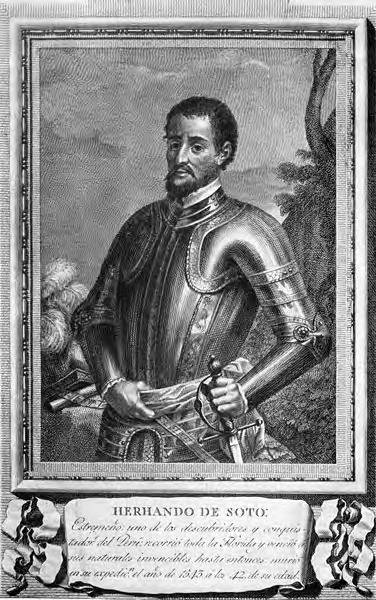
Hernando de Soto - Explorer or Greedy Grave Robber?


Hernando de Soto
Explorer or Greedy Grave Robber?
by Angela L MSSPI


Hernando de Soto was born between 1496 and 1500 in the mountainous area of Jerez de los Caballeros in Badajoz Spain. At the age of 14, de Soto sailed for the Isthmus of Panama with the aging governor of Darien, Pedro Arias Davila. He had seen many shipments of products and goods from the Indies as a child. Gold, sugar, herbs, cotton, hides, and wood inspired many stories of the possibilities for riches and promise across the Atlantic.
While serving under the harsh Davila,(right) de Soto earned a reputation as a conquistador known for his stubbornness, bravery, and boldness. As reward for his raids of Indian land and treasures, he received gold and slaves. De Soto had served as Lieutenant for Francisco Pizarro during his expedition to conquer the Inca Indians. Since Pizarro was successful in conquering the Incas of Peru, de Soto shared in the wealth and made a fortune for his work in Mexico.

Some sources claim that In 1537 de Soto married Ines de Bobadilla ,the youngest daughter of Pedro Arias Davila. The Southern Frontier by John Anthony Carusso (1969) however, claims that her name was Dona' Isabel.
On the Wikipedia link for Davila, Ines de Bobodilla is listed as the wife of Davila and Isabel is listed as the daughter. So there is some confusion as to her actual name.

After serving under Davilla in Central America and under Francisco Pizarro (left) in Peru, the dashing young conquistador was made governor of Cuba by Emperor Charles V.


Many a tale had been told by the Indians in Mexico (New Spain) about seven cities to the north where precious jewels might be found in abundance and gold in such quantities that ordinary tools were made from it. King Charles V of Spain ( pictured right) also heard of the reported wealth waiting to be discovered.

As a result, he gave de Soto a grant to lead an expedition to Florida to conquer, and subdue the population and bring back the riches. He was given the rights to take what he wanted and enslave the native people if necessary, to aquire it.


On 18 May, 1539, de Soto set sail , (leaving his bride in Cuba) with a fleet of nine vessels. He had with him 1000 men exclusive of the sailors, all well armed and making up what was considered to be the best equipped expedition that had ever set out for conquest in the New World. Some sources listed him as leaving in 1538 with seven ships, about 600 men, 250 horses, and many bloodhounds.
According to John A Carusso's book The Southern Frontier (1969) de soto was also granted a track of land, 12 leagues square, anywhere in Florida that touched neither seaport or chief town. He was free to import, one hundred Negro slaves , a third of whom would be women, which were given to him free of duty. King Charles V also laid claim to half of all gold, jewels, silver, pearls or any other objects of value, which de Soto might obtain while on the expedition. De Soto was given authority by the King to plunder burial grounds, seplecures, Indian temples and sacred sites. After the Kings cut ,the spoils were to be divided equally among the conquerers.
They proceeded with favorable weather until 25 May, when land was seen and they cast anchor in a bay to which they gave the name of Espiritu Santo (now Tampa Bay). The army landed on Friday, 30 May, 1539. That was the start of an adventure that took de Soto and his band nearly halfway across the continent in search of gold, silver, and jewels.


Hernando de Soto is widely known for his expeditions,and his discoveries and is considered the first white man to see the Mississippi River. However in my research and reading the stories of his many conquest, I found that he was a vicious fighter, frequently raiding Native villages, killing or enslaving all in the way of his quest to discover riches. He would have the elders of the villages shot in open fields in execution lines, he made examples out of the warriors, placing them in chains, he also took many as slaves and guides on his expeditions. Most history books and educators will tell you of his brave struggles to explore. But in my reading and researching the subject of Hernando de Soto, I was quite surprised to see what a gold greedy and pitiless conqueror he was and his blatant mistreatment of the Native American Tribal People. Sometimes, he never even attempted to talk to them first, he would scout out their villages and attack without warning, pillaging for treasure.

He also brought with him to the New World , pigs. The pigs were to be used as starters for pig farms in the new Spanish colony. Some were gifted to local chiefs who soon enjoyed the taste of cooked swine and adapted the meat to their barbacoas (barbeque) or raised cooking platforms. The remaining pigs served as emergency food sources during De Soto's trek through Florida, Georgia, the Carolinas, Tennessee, Alabama, Mississippi and Arkansas.


But these same pigs may have left a terrifying invisible legacy. In their book, “The Hernando de Soto Expedition,” Ann Romenofsky and Patricia Galloway suggest that millions of Native people died because they lacked previous exposure to swine borne diseases, This previous exposure was critical in building their immune systems against the deadly diseases. These diseases include brucellosis, anthrax, leptospirosis, tuberculosis, trichinosis, cysticercosis and various strains of flu. Considering the fact that many swine diseases can be transmitted to deer and even turkeys, the two most important food animals used by southeastern Indians, the likelihood that this occurred becomes even greater.

When arriving in Confitachequi, he met an Indian Princess. She gave him a string of pearls as a welcome gift. He would later discover that the burial grounds were loaded with buried treasures of pearls. So he looted the burial grounds of 350 pounds of pearls. But de Soto was not satisfied with pearls, and decided to push forward. While the princess had accepted him and treated him most graciously, he had plans to take her along as part of his expedition as an interpreter. When she declined his invitation, he put her under guard and forced her to march on foot with his female slaves. But the princess managed to escape with a trunk full of pearls. De Soto did not pursue her.

Moving up thru Tennessee and back down the Alabama River to the province of the Mobile Indians, de Soto met Chief Tuscaloosa

( Tuscaluza...Encyclopedia of Alabama ). Chief Tuscaloosa was a giant of a man, as tall as 7 feet, standing a foot and a half above the Spaniards. At night fall the Chief began to prepare to leave and return to his village, but de Soto objected and took him into custody, thus making a formidable enemy.

While the Chief made a show of trying to obtain 400 carriers for the Spaniards expedition, he secretly sent word to summon his warriors and inform them of his detainment. Tuscaloosa's plan was to entice deSoto to the village of Mabilia which was fortified.


Mabilia was said to be located somewhere between the Alabama and the Tombigbee Rivers in present Clarke Co Alabama.

Unknowingly, de Soto would led his people into the arms of a savage confrontation. Tuscaloosa told de Soto and his expedition to leave in peace, or he and his allies would force him to leave.

When de Soto sent men into the house to retrieve the chief, it was discovered the house was full of armed warriors prepared to protect their chief. De Soto then asked the Chief of Mabila to demand the porters promised by Tuscaloosa, and the Spaniards would leave. The man refused, and a Spaniard grabbed him; in the ensuing scuffle, the chief had his arm cut off by the Spaniards sword. With this, the Mabilians attacked the Spanish, who immediately ran for the gate and their horses.

Natives poured out from all of the houses and began to attack the Spaniards. The Mabilians grabbed the provisions and equipment left outside the palisade and brought the supplies into the town. After making it outside, the Spaniards regrouped and began an assault on the village After a day long battle, Mabila was burned down, and nearly all the Mabilians and their allies were killed, either in the battle, in the subsequent fires, or by suicide. The natives would rather take their own lives than become slaves of the white man. Chief Tuskaloosa's son was found among the dead, although the chief himself was not. Biedma asserts that over five thousand were in the town, of which almost none were able to escape.

De Soto learned that his army was less than a week's travel from the coast, where his supply ships lay at anchor. However, fearing mass desertion and unwilling to abandon his enterprise, the Governor suppressed the news and instead led his battered, ill-equipped company northward into Mississippi, where they endured another cruel winter.

Resentful of de Soto's demands for food, blankets and furs, a group of Chickasaw Indians attacked his camp at night, successfully setting it ablaze. People, livestock and equipment perished; the expedition was left virtually naked. But despite this second devastation, the Spaniards rallied themselves amazingly and spent two weeks fabricating weapons and gear from local materials and salvaged effects. When the Chickasaw returned, the Spaniards defeated them easily, but it was clear that the mission had to continue westward out of this hostile territory.

 The Florida Wildlife Div. differs in opinon as to the route of exploration that deSoto took. None of his original maps are still in existence and while there were several writings describing the expedition and the things encountered, language was a barrier so there is a dispute as to which map is correct so I have included them both.


In May, de Soto and his men reached the Mississippi River, the first Europeans ever to do so. Desoto named the River, The Rio Grande de la Florida, meaning " The Great River of Florida. But the Native Americans in their wisdom, continued to call the river, "Mississippi Father of Waters". Stunned by its size but scarcely aware of the importance of their discovery, the Spaniards moved quickly to build barges for crossing - not only to avoid conflict with brooding locals, but also to continue their relentless quest for riches.
The expedition wandered through modern-day Arkansas and Louisiana for nearly a year until finally it became clear to everyone, including the Governor, that no fortunes would be found. Resigned, exhausted and ailing, de Soto proposed that his army return to the Mississippi, build boats and float down the river, then send a barge to Cuba for help.

However, before he could effect this plan, de Soto died on May 21, 1542 of a fever. His body was wrapped in skins weighted with sand and dumped into the Mississippi River, in order to prevent the desecration of his body by the Indians, whom he had intimidated and ill-used . There is a cross marker commemorating the explorer and his discovery on the banks of the Mississippi, in the city of Memphis TN.

The county of Desoto in North Western Mississippi is named for the explorer and beautiful murals, depicting his expedition, grace the ceilings of the Desoto County Courthouse in Hernando Mississippi.

Although the expedition of deSoto ended drastically and with little success in the venture for riches, it was one of the most elaborate and persistent efforts made by the Spaniards to explore the interior of North America. It was the first extensive exploration of at least six of the Southern states: South Carolina, Georgia, Florida, Alabama, Mississippi, and Arkansas, and their written history often begins with narratives which tell the story of de Soto's expedition. From these same narratives we also get our first description of the Cherokees, Seminoles, Creeks, Appalachians, Choctaws, and other famous tribes of southern Indians.


The story of this expedition also records the discovery of the Mississippi and the first voyage of Europeans upon it. While history gives credit for the discovery of the Mississippi River to Hernando de Soto, it must be noted that Alonso de Pineda discovered the mouth of the Mississippi in 1519, and that Cabeza de Vaca ( right) crossed it near its mouth in 1528.


Sources:

The Southern Frontier ( 1969) by John Anthony Carusso, Professor of History West Virginian University.
The Columbia Encyclopedia, Sixth Edition . Copyright 2008 Columbia University Press
SMITH tr., Narrative of the Career of Hernando de Soto in the Discovery of Florida, by a Knight of Elvas (New York, 1866);
SHIPP, History of Hernando de Soto (Philadelphia, 1881)
Library of Congress, Washington, D.C.
Hernando de Soto in Florida, 16th-century engraving by Theodor de Bry
Hernando De Soto. In The Catholic Encyclopedia. New York: Robert Appleton Company. New Advent: hhttp://www.tuscaloosa-alabama.com/history.html
http://www.newadvent.org/cathen/04753a.htm
http://www.tcf.ua.edu/tcfgallery/d/857-2/image025.jpg Chief Tuscaloosa plaque
http://www.archives.alabama.gov/brnzdrs/1.html Desoto & Tuscaloosa
http://thinkspain.com/news/new-ReduceImgWidth.asp?foto=foto17080_2.jpg&width=250
http://www.nativevillage.org/
http://www.sjsu.edu/faculty/watkins/cabeza.jpg
http://www.gaspadine.lt/dokumentai/franciskas_pisaro.jpg
http://www.floridahistory.com/inset78m.html
http://en.wikipedia.org/wiki/Pedro_Arias_D%C3%A1vila
http://www.britannica.com/EBchecked/topic/555096/Hernando-de-Soto
http://www.elizabethan-era.org.uk/hernando-de-soto.html
http://www.eduref.org/cgi-bin/printlessons.cgi/Virtual/Lessons/crossroads/sec4/Unit_2/Unit_IIQ2R5.html
http://www.newadvent.org/cathen/04753a.htm
http://www.bigsiteofamazingfacts.com/who-was-hernando-de-soto
http://international.loc.gov/intldl/eshtml/es-1/es-1-2-2.html


Tuesday, July 13, 2010

Early Settlers On The Pototoc Trail - Potts Camp, MS.

The Pontotoc Trail, used for so many years by the early settlers of Mississippi, was once an old Indian trail. Later it became a road. Although Mississippi became a state in 1817, Choctaw and Chickasaw Indians held a large part of the land. By the treaties of Dancing Rabbit and Pontotoc of 1830 and 1832, the Indians agreed to give up the land in the Mississippi and move west of the Mississippi River. Colonel Erasmus Ferdinand Potts, born August 21,1801 in South Carolina, traveled the Pontotoc Trail to the Federal Land Office in Pontotoc Ms. in 1836 to purchase land and settle and raise a family.

Col. Potts purchased several sections of land in Marshall and Benton Counties. He also owned land in the Delta. His first home, and a large trading post, was built on the Pontotoc Trail, a short distance from the Tippah River. At this time in history before erosion of the hills, Tippah River ran wide and deep with steep banks, so there were only a few places it could be forded. Where the Pontotoc Trail passed, east of the river was a natural ford, with a broad field and a high bluff on the south. From the bluff poured cool springs of water and the trees near by for firewood made this an ideal place for weary travelers to stop overnight. They used wagons, buggies, and horseback for transportation and as a long journey usually took several days, Colonel Potts encouraged people to stop at the camping site and furnished them with supplies. His hospitality became so widely known, people began to call the place Potts Camp.

Records show that Colonel Potts owned many slaves, cultivated a vast acreage of crops and raised hundreds of head of cattle, driving them overland to Memphis to be sold, or shipped to New Orleans on cattle boats. He also shipped quantities of grain.

Colonel Potts built a 22 room mansion and a girl's school named "Woods Academy". Mary Potts, and her mother, Elizabeth, were instructors there. The school burned in 1855 and the students were transferred to Pontotoc.

In 1856 Potts invested in the Mississippi Central Railroad and furnished most of the material and labor for the section between Holly Springs and Oxford. He became master mechanic and one of the directors of the railroad company. The entire railroad was completely destroyed during the War Between the States. Because of the mud and dusty roads, Potts and his workers layed boards a long distance on the Pontotoc Road. They built the first levee in the Mississippi bottom, also Tippah River bottom.

The first Potts Camp Post Office was built of logs near his home, with Colonel Potts' daughter, Mary, as the first postmistress. It closed when the Civil War started n 1861. Elizabeth Brownlee, whose family settled near Columbus, was the wife of Colonel Potts. They reared three children; another child died at age two and a half years old. ( photo top right Potts Camp in Pioneer Days, courtesy of Dale Potts Hollingsworth)

When the war broke out, Colonel Potts, was too old to fight, so instead, he spent his time and money to help the Confederacy. No one really knew how he came about the name Colonel, however it happened, he had the name before the Civil War.

The Federal Troops stationed in Memphis and Holly Springs rode through the country raiding homes, burning barns and houses and stealing horses, food, and valuables. When the Federals began to take over this area Colonel Potts counted his gold and silver one night, blindfolded two slaves to go with him and rode away in a wagon. After the men dug the holes to bury the treasure, they were blindfolded again. I could find no record or knowledge if it's location was ever known or discovered.

Colonel Potts was arrested, tried on three counts, and convicted for helping the Confederacy. He was sent to Memphis then to Alton Federal Prison (near St. Louis, MO, on the river banks). He was too old to stand the brutal treatment, so the first settler of Potts Camp died December 16, 1863. Federal Troops brought his body home in a metal box filled with shavings. His wife wouldn't let them bury him until she examined the body to be sure it was her husband. After finding a scar on his ear she was satisfied, so they buried him in "Potts Cemetery", near Winborn. After the Federals helped bury Colonel Potts they ripped the carpets from the floors of his home, loaded them in the best carriages the family owned and drove away.

Later in 1870 Elizabeth was buried near him.

His son, James Benton Potts ,was injured while serving the Confederacy and never completely recovered. James B. is buried in Hillcrest Cemetery in Holly Springs.


Mary A Potts Reid was the youngest child of Colonel Erasmus Ferdinand Potts .
Mary was born Jan 28, 1840. She attended college in Memphis, Tn and she was fondly favored by her father , who gave her a wonderful party with friends for her wedding. She married Mr. Fant and they had two children, Dora and a son who died very young. Later Mary divorced him. Mr. Charlie Reid became her second husband they reared one son, Cornelius Potts Reid. I found this an unusual bit of documented history, Mr Charles Reid purchased the first bathtub in town and later sold it to Mrs. Julia Porter for her hotel. It was later sold to Sam Howell a local farmer, to use as a watering trough.
Corneille was born, November 11, 1877. Corneille married Mary Lou Anderson of New Albany, Ms. Mary Reid gave her son Corneille the gift of a Bible, which held the following poem, written to her son on Dec 31, 1894.


To My Dear Boy
by Mary Potts Reid


When tempted son, to go astray
Pause, pause, my child; O turn away
From sin's alluring form.
Go to thy chamber and, when there,
Check in thy mother's gift a prayer
A refuge from the storm.

Read, my dear son, believe and live
Than not in vain, this Book I give
To my own darling boy.
Twill smooth for thee life's stormy path
Teach thee to shun thy Maker's wrath
And wear his crown of joy.

When grief shall check thy young heart's mirth
To weep that she who gave thee birth
Has passed into the skies
Then ponder o'er thy mother's gift
It will thy drooping spirit lift
And dry those weeping eyes

And as your hands it's pages turn
Resolve dear boy, of Christ to learn
Be lowly, meek and mild
Remember she who gave this book
May though unseen, upon thee look
Rejoicing in her child.


Mary Potts Reid donated numerous plots of land to the town of Potts Camp including the church lots for both Baptist and Methodist churches in town, school lots, and cemetery land.

The Reid's Gift Missionary Baptist Church and Cemetery (African American) are named in her honor, as is, the Mary Reid School. The New building for the Reid's Gift Church was re-built in the 1940's. It sits just on the edge of town on Old Hwy 78 on a small hill.
Mary also donated land for a right of way, when the Frisco Railroad came through this area in 1886. The settlers and merchants of Col Pott's camping ground built a depot about a mile from the river, more settlers and merchants began moving into the area, and they decided on the name their village in honor of Col Potts, who had first settled the land which would later be established as a levee camp in the 1870, and would emerge as the town of Potts Camp in 1912.


Mary A. Reid played an important role in the settlement and growth of Potts Camp by donating large amounts of land to the developement of the community. She was fair and loved by most who knew her, The African American Community as well as the white settler's thought very highly of her.

Mary Potts Reid, her husband Charles and son Corneille are buried near the front section of the Potts Camp Cemetery near the front gate.


The Potts Camp Cemetery


headstone of Mary Potts Reid. Potts Camp Cemetery


The poem and photos of Mary Reid and Col. Potts were used with permission by Mrs Dale Potts Hollingsworth. I had the pleasure of visiting the home of the 94 yr old grt-grt grand-daughter of Col. Potts in May of 2010. Mrs Hollingsworth still lives in Pott's Camp in the home her grandfather, J.A Pott's built in 1910. She is still a writer for The South Reporter, newspaper and is known to most locals as "the town historian". She is also the author of Memories of Potts Camp on the Old Pototoc Trail. published in 1978. She was so kind and gracious to spend some time talking and answering questions with me, about her family and the history of Potts Camp. Without her stories and written records, past down thru the generations, and her willingness to keep the towns history alive, this article would not have been possible.


Headstone of Mary Potts Reid's son, Corneille Potts Reid. Mother & son died 3 months apart. Husband, Charles H Reid died April 17, 1921. According to Mrs. Hollingsworth, the land for the Potts Camp Cemetery was also donated by Mary Potts Reid.
 
Photos and interments of both the Reid's Gift Missionary Baptist Church Cemetery and The Potts Camps Cemetery can be found on the FindAGrave.com website. (see link below)


Sources:
Personal Interview with Dale Potts Hollingsworth 2010 by Angela L Burke.
Memories of Potts Camp on the Old Pototoc Trail by Dale Potts Hollingsworth published 1978
The South Reporter Newspaper, archive articles by Dale Potts Hollingsworth.
Reid's Gift Cemetery & Potts Camp Cemetery photos by Angela L Burke

Tuesday, May 11, 2010

Hillcrest Cemetery Holly Springs Mississippi

Hillcrest Cemetery came into use in the 1830's, following the Chickasaw Secession. Most of the oldest and earliest headstones have long ago crumbled and been carted away. But there are a few remaining stones that mark this early era. Leaving only a small clue as to the original age of the cemetery.
While many prominent plantation families had their own family plots set aside on their own land, there were many prominent citizens, as well as, those whos' wealth did not afford them a private family burial grounds.


Some of the oldest markers left standing at the Hill Crest are :
( Click highlighted links to see Find A Grave Memorials, Photos & Headstones.)


Martha E Blake wife of M Blake who died Sept 12, 1839


Originally, only a few small acres were set aside for the Hill Crest Cemetery, in a tree shaded area at the crest of the hill, but as more and more settlers came into the area, the cemetery was required more room. As the cemetery began to expand, the stables and lot of the Sims Stagecoach Stand was taken in as eventually was the baseball field. The cemetery now encompasses approximately 25 acres.

Will Coyle was the first person to be interred in the new section of the cemetery, the area which was formerly a baseball field, which became part of the cemetery in 1905. Ironically, Will Coyle was killed with a baseball bat.

Hill Crest Cemetery has long been known as Little Arlington to the locals. All but two of the twelve Generals from Holly Springs, who marched away to war in 1861, are laid to rest here.


Brigadier General Absolom M West


Adj-General Thomas A Falconer


Asst. Adj-Genera Harvey W Walker


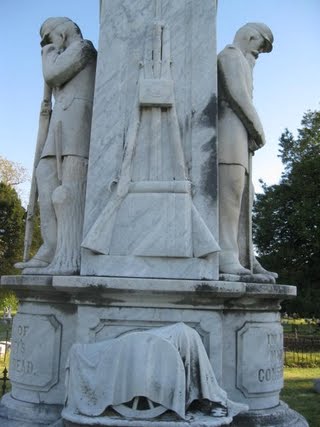
One of Two Confederate Memorials


Micajah Autry one of the martyrs of the Alamo has a memorial shaft here. He perished during the days between Feb 23, and March 6, 1836 when 150 revolutionist were killed at the Alamo Mission in the Texas War of Independence.

Samuel A Cole of the Marshall Guards fell at Matamoros Mexico in October 1846 during the Mexican War is also at rest here.


John Lester, one of eleven men who were the first to be taken prisioner in World War I is honored here with a memorial. He had been taken prisioner with 10 others in the Toul section of France on November 3 1917.Lieut.

Colonel James L Autry was in command at Vicksburg, when a federal fleet under the command of Admiral Farragut steamed up the Mississippi River from New Orleans in 1862. Farragut demanded the surrender of Vicksburg. Col Autry's reply to this demand:

 " Mississippians do not know how how to surrender, nor do they care to learn."


The Federals opened fire on the city, filled with women and children. This bombardment lasted for several day, but caused little damage. Col Autry was killed in battle on Dec 31 1862 and his body was returned to his home in Holly Springs
 
There are also numerous politicians, judges, statesmen and senators buried here including Hiram Rhodes Revels, the first African American Senator of Mississippi, who was liked and respected in the community.


Yellow Fever struck Holly Springs in the 1870's . Six of the twelve nuns of the Sisters of Charity are laid to rest side by side at Hill Crest, they had nursed and cared for the victims of the fever and then became victims themselves. All meeting their fate within a weeks time of each other. Father AnacletusOberti who had taken charge of the Court House hospital also became a victim of the fever and is buried near the sisters. The citizens of Holly Springs out of appreciation of the service so graciously given them by the Sisters and Father Obererti collected funds and erected a monument in their memory the year after the fever epidemic.
When yellow fever first came to Holly Springs in 1870, all who were able fled the town to avoid contamination. Out of a population of 3500, only 1500 were left in the town and 1440 of them contracted the disease.

Mayor Goodrich was the first person to die of the epidemic. He died on August 31st, 1878. You may visit the The Yellow Fever Martyrs Church and Museum (circa 1841) East College Ave., Holly Springs, MS 38635, 662-252-3669, Museum dedicated to preserving the legacy of seven Catholic martyrs who gave their lives during the Yellow Fever epidemic of 1840. Open by appointment only.

Another popular set of headstones at Hillcrest is that of Mammy, the 94 year old nanny of the prominent Coxe Family. She is buried in the family plot in a place of honor with the family she so lovingly cared for. Her tombstone inscription reads " Mammy, Faithful Unto Death"
The small headstone in the photo on the left, that is turned to face sideways, is Mammy's Headstone.


Hillcrest Cemetery is the setting for storytelling as local townspeople, dressed in costumes of the day, re-enacting roles of Holly Springs' most illustrious characters at the Annual Holly Springs Pilgrimage, held every year in April. You can take a walking tour of the cemetery and here stories related to those interred here.

To learn more about the history and lives of those buried at the Hillcrest Cemetery you can also visit the Marshall County Historical Museum located on Van Dorn Ave, you can reach it by dialing 662-252-3669.


See More Photos


Sources:
Find A Grave.com
It Happened Here True Stories of Holly Springs by Olga Reed Pruitt 1950 South Reporter Printing Co
Images Of America Holly Springs by Alice Long & Mark L Ridge 1998
Childhood In Holly Springs A Memoir by Chesley Thorne Smith 1996
http://www.visithollysprings.com/pilgrimage.html
Marshall County Historical Museum

Hillcrest Cemetery
Elder Street
Holly Springs, MS 38635
662-252-2515

Sunday, May 2, 2010

A Tragedy In God's House by Angela L

Christ Episcopal Church
Holly Springs MS
Marshall Co.
 
The Christ Episcopal Church sits magestically on the corner for Randolph & Van Dorn in downtown Holly Springs, Ms. It was built in Gothic style, complete with a slave gallery, gorgeous stained glass windows and fine wood details.

But, the history of, the tragic death of a well known and respected Reverend, would forever linger in this beautiful and quaint  House of God.


The story begins with Joseph Holt Ingraham , formerly head of St Thomas Hall, a diocesan school for boys, and designer and builder of St John's Church in Aberdeen in the early 1850's. He was present as rector at the time of consecration of the Church on October 6, 1858.
 
Joseph Holt Ingraham was born in Portland, Maine, January 26, 1809, the son of James Milk Ingraham and his wife, Elizabeth Thurston. His grandfather, Joseph Holt, was a ship builder and trader, and the grandson shipped on board of one of his vessels as a sailor before he was seventeen and traveled to Buenos Ayres. While in South America he is said to have taken part in a native revolution.

After his return, according to his brother, the Rev. J. P. T. Ingraham, he entered and was graduated from Bowdoin College, but ,it is said that, a search of the Bowdoin College records by the registrar, failed to substantiate this. The Quarterly Church Review says he entered Yale College but was not graduated.
Around 1830, he went to New Orleans, and then to Natchez, Mississippi, where he tried the law, but abandoned it,to become a teacher in Jefferson College, Washington, Mississippi—hence the title "Professor" which was often affixed to his name in his publications. While in this school he began writing, and in 1835 published "The Southwest, by a Yankee." The next year "Lafitte, the Pirate of the Gulf," the first of his novels of the type that was to make his name well known to his contemporaries.


He married Mary Brooks, the daughter of a wealthy planter near Natchez, Ms, became a priest and spent the remainder of his life in parishes across Mississippi. He was the author of romance in his early writing career and later went on to write religious fiction.


On December 8, 1860, Ingraham took a loaded pistol from a drawer in the vestibule of his church while his young daughter waited for him on the porch. It's been said, that there had been some recent robberies in the area, which prompted the Reverend to carry a pistol. It slipped from his hand and in falling to the floor, it discharged. The bullet entered his thigh, passed up his side, and caused intense suffering for some ten days. Joseph H Ingraham died on Dec. 28, 1860. The suggestion of a suicide attempt was reputed by the family and the community believed and still does, that the shooting was an accident.


Inscription:


"Minister of Christ, Scholar, Author, and Rector of Christ Church Holly Springs" Born in Maine. Died in Holly Springs. Erected by J. T. Pickett D.D.

born Jan 28, 1809

died Dec 18, 1860


Reverend Joesph Holt Ingraham is buried on the western edge of the Hillcrest Cemetery in Holly Springs, Ms Marshall County. Today the twisting branches of a giant English Yew, rare in the state of Mississippi, enshrouds his grave and the tall monument is surmounted with a cross. The monument was erected by
 JT Pickett D. D. with donations given by his parish. He was survived by his wife Mary Brooks Ingraham , his son Prentiss, and three daughters.


Special Thanks to Michelle Woodham, volunteer headstone memorial and photo contributor at the find a grave website below. She has graciously volunteered her time to set up over 29,000 memorials and contributed over 57,000 headstone photos to the project. As well as contributing her headstone photos for Joseph Ingraham to this article.

Sources:

Mississippi Home Places notes on Literature and History by Elmo Howell 1988 available for purchase at the Marshall County History Museum, Holly Springs, Ms.
www.ulib.niu.edu/badndp/ingraham_joseph.html- Joseph Ingraham Portrait photo. You can read more at this site.
Photo by Michelle Woodham FindAGrave contributor: Rev Joseph H Ingraham Memorial site:
http://www.findagrave.com/cgi-bin/fg.cgi?page=gr&GSln=Ingraham&GSfn=Joseph&GSiman=1&GScid=59893&GRid=12212059

Wednesday, April 7, 2010

Daltons of Lafayette Co Mississippi

I have been wanting for some time now to write about my relatives. My maiden name is Dalton. I have spent all my life being asked " Are you related to the famous outlaws the Dalton Gang? " While I have spent many years trying to find the answer to this question, I still have not been able to make a connection. But it is really not a big deal to me either way. I would like to share some information that I do know about the family tree. Most of my Dalton relatives are buried at the Shiloh Baptist Church Cemetery in Lafayette Co. Ms.
I have been visiting this cemetery since I was a little girl. I use to go there with my grandparents all the time to put flowers on the gravesites of our departed relatives. I can remember when this cemetery was on a dirt road which dead ended at the cemetery. Now there is a two lane blacktop road right thru the middle of it. The new section across the road from the church was nearly empty in those days but now is almost full.


John Granvill Dalton was born July 7, 1889  in Corinth Ms and lived with his parents James Thomas (Tom) Dalton and Georgia Ann Duncan . He is listed in the 1902 Educatable Children of Alcorn Co Ms, Township 1 Range 9 as being age 12. Along with his brother Ezra age 16, sister Hattie (Holly) age 13, brother Jim age 10 and Sam age 5. Other children not listed were Mandie, Irene and Elmer. It has been reported to me that Ezra and Sam lived in Pontotoc, but I have no information to verify this claim. There is also a family story that Sam owned a grocery store somewhere in Pontotoc and there had been several robberies in the area, so Sam decided to stop the theives by rigging up a shotgun tied to a chair and if someone tried to open the door they would get blasted by the shotgun, unfortunately one day Sam went to open up the store and forgetting about his shotgun rig ,opened the door only to be shot and killed in his own store. There are also claims that Ezra got into a bar brawl one night and beat a man to death. Part of Granvill's farm was sold to pay for his bail. I do not have any documentation as to the truth of these claims, these were stories told to me by my dad.

John Granvill married Pearle Starnes, (pictured above) date of marraige is not know but they had six children James b. May 12, 1914 d. July 20, 1988, Earnest b. July 27, 1916 d. July 7, 1988, Cecil ( dates unknown), Flavil b. 1925 d. 1962, William and Dovie Mae b. Mar 24, 1921 d. Oct 18, 1922. All but Cecil are buried at the Shiloh Church Cemetery. It is said that Cecil lived in Louisiana, but I spoke with him by phone in the late 1990s at which time he was living in Memphis, Tn and was ill with cancer. I do not know what became of him or where he is buried. Flavil died in 1962 at the age of 37.  Uncle William was the youngest and wildest of the bunch and there are many family stories about how he was a moonshine runner back in the day. He passed away in 2006.

Pearl Starnes was born June 13, 1893 and was the daughter of Henry Allison and Josie Starnes, also buried at the Shiloh Cemetery. She passed away April 10, 1954. 

Over the years I have heard many stories about the Shiloh Cemetery from my dad. One story that I have heard many times over the years is that there was an unmarked Confederate Mass Grave at the Shiloh Cemetery which was once surrounded by cannon balls to mark the sight. Over the years, the cannonballs have been stolen one by one and there are no longer any left, so the exact location of the grave site is unknown. There has also been numerous acts of vandalsim at the cemetery, which has contributed to the story that there is a Confederate Soldier who walks the cemetery at night standing guard.  In the early 1950's there were heavy rains in Lafayette Co causing flooding in the cemetery at which time some of the Confederate bodies came to the surface, Granville & his son James  along with other members of the Shiloh church, helped to rebury the bodies. The older section of the cemetery was once overgrown with tall grass, and when I was a little girl, I was not allowed to wander into this section of the cemetery. Now, the cemetery is kept up by members of the Shiloh Baptist Church which sits adjacent to the cemetery and the older section has been cleared.

James Everett Dalton was my grandfather and son of Johnny Granvill Dalton. He was born in Lafayette Co MS May 12 1914. He married my grandmother Grace Donaldson  daughter of Luther Paul Donaldson and Martha Ann Pounds of Paden Ms., on April 22, 1934. They had 5 children, Margarite June b.. July 9, 1936, d. July 10, 1936, Jimmie Morris bSept 5, 1941 D. Sept 6 , 1941, Carol Grace b. Jan 7, 1943 still living in Desoto Co Ms, Jerry Glenn ( my Dad) b. Sept 29, 1946 still living in Marshall Co Ms and Jeanie Diane b. Jan 12, 1949 living in Biloxi Ms.  James Everett Dalton was a retired carpenter of Carpenters Local 345, a US Navy WWII veteran, serving on the ship Proteus during WWII, He was a deacon and member of Beverly Hills Baptist Church in Memphis Tn and died of complications from back surgery on July 20, 1988. He was an avid fisherman and frequently took the grandchildren fishing, he was the first person to teach me how to bait a hook. He was also a wonderful gardener and frequently sold turnip greens, corn, tomatoes, cantalope and watermelons in the front yard of his home in Memphis Tn. Every one knew him as Mr Jim.. He was a quiet man and always had a toothpick in his mouth. I have very   fond memories of my grandaddy and I miss him very much.

This photo above is of 4 generations of Daltons. James E, Granvill, Jerry and his oldest son Jimmie. It was taken at the nursing home a few months prior to Granvills death in 1972.


Baby Pictures of James E Dalton and Grace Donaldson
my grandparents

Headstone of Granvill & Pearl Dalton


Headstone of Earnest Dalton & wife Ophelia


William Daltons grave marked only with a footstone.

Headstone of James Everett & Grace D


Will B Dalton was the brother of Granvill's father Tom Dalton
his wife Katie lived to be 108 yrs old.

The Known Dalton Family Geneology:
Thomas Granvill Dalton b. 1830 in Alabama. He married Jan. 27, 1854 in Tishomingo MS to Sarah Elizabeth Asbell. Thomas Granville died March 1880 in McNairy, TN.
  • Known children: James Thomas Dalton & Mellisa Jane Dalton and Will B Dalton
James Thomas Dalton b. Jan 13, 1859 in TN Married Georgia Ann Duncan b. June 27, 1861 d. Oct 1, 1949
  • Known children: Ezra- b 1886, Hattie ( Holly) b. 1888, John Granvill, b. July 2, 1889, d. Dec 28, 1972, Jim b. 1892, Sam b. 1897, Mandie, Elmer, Irene.
John Granvill Dalton b. July 2, 1889, d. Dec 28, 1972 married Annie Pearl Starnes b June 13, 1893 d. April 10, 1954
  •  Children: James Everett, Earnest, Cecil, Flavil, William and Dovie Mae
James Everett Dalton b. May 12 1914 d. July 20, 1988 married April 22, 1934 to Grace Donaldson b. Jan 17, 1915, d. Aug 4, 1998.
  • Children: Marguerite June, Jimmie Morris, Carol Grace, Jerry Glenn & Jeanie Diane
Jerry Glenn Dalton b. Sept 29, 1946 married Toni Clayton Williams on Sept 3 , 1965

  • Children Angela, Jimmie, Daniel, Deborah & Jeremy
Most of the remaining Daltons and there are too many to list, now reside in Marshall and Desoto Counties in Mississippi